
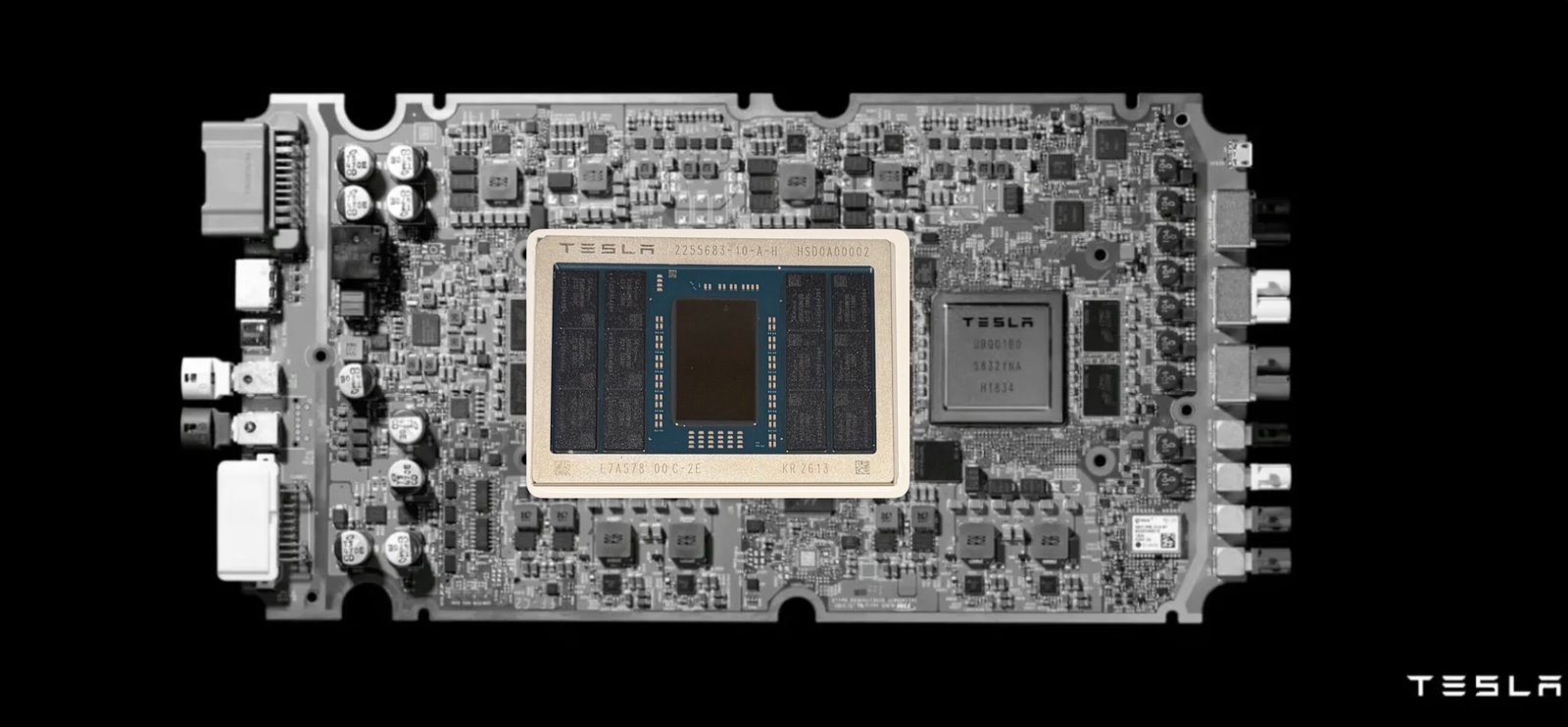
Tesla Tapes Out AI5 Chip Nearly Two Years Behind Schedule
Elon Musk confirmed Tesla has reached a critical milestone in its self-driving chip development—tape-out of the long-anticipated AI5 chip—though the delay underscores the immense complexity of building purpose-built AI hardware for autonomous vehicles.
The announcement, made late Tuesday night, marks the point where Tesla’s final chip design is sent to a semiconductor foundry for physical fabrication. While the news signals progress toward full in-house AI processing, it also reveals Tesla has fallen significantly short of its original timeline—nearly two years after Musk first promised the AI5 chip would land in production vehicles by 2024.
[Image: Rendered diagram showing Tesla AI5 chip layout and key components]
What Tape-Out Really Means
Tape-out is a major engineering milestone in semiconductor development. It signifies that the chip’s design is complete, verified, and ready for manufacturing—essentially handing off the blueprint to a foundry like TSMC or Samsung Foundry to produce the physical silicon wafers.
However, tape-out does not mean the chip is ready for deployment. After fabrication, the chips undergo rigorous testing, integration into hardware units, vehicle validation, and regulatory certification—processes that typically take 12–18 months—even under optimal conditions.
Timeline Delays Highlight Industry Challenges
Tesla’s AI5 development has faced repeated setbacks:
- 2024 (Original Target): Musk initially stated AI5 would debut in vehicles this year
- Early 2025: Timeline pushed to late 2025 after hardware redesigns
- Mid-2025: Reportedly delayed again as software-hardware co-design proved more complex than expected
- April 2026 (Current): Tape-out achieved, but volume production now expected Q4 2027 or later
This delay reflects broader industry realities: designing AI chips for autonomous driving requires balancing performance, power efficiency, thermal constraints, and safety certification—all while adapting to rapidly evolving neural network models.
AI5 vs. Previous Generations: Key Upgrades
Tesla’s new chip promises substantial improvements over its current Full Self-Driving (FSD) Computer v3 hardware:
- 10x+ increase in AI inference performance—from ~72 TOPS to over 700 TOPS per chip
- Dedicated vision transformer (ViT) acceleration—optimized for Tesla’s shift from CNN-based to transformer-based perception models
- Lower power draw—critical for extending range and reducing cooling demands
- Full in-house development—unlike previous chips co-developed with NVIDIA, AI5 is designed entirely by Tesla’s autonomous team
These enhancements are foundational to Tesla’s goal of achieving “true” Level 4 autonomy without human intervention—and doing so at scale across its global fleet.
What Comes Next? The Road to Production
Following tape-out, Tesla must navigate several critical phases before shipping AI5-based vehicles:
- Mask set finalization and wafer fabrication (3–6 months)
- Chip packaging and initial testing (2–4 months)
- Integration into hardware units (Hardware 5.0) (4–6 months)
- Vehicle integration and validation testing (6+ months)
- NHTSA and global regulatory approvals (variable timeline)
Industry analysts estimate the earliest AI5-powered vehicles could reach customers in late 2027—if no further delays arise. In the near term, Tesla will continue shipping vehicles with its current FSD Computer v3 hardware.
Critical Context: The AI Hardware Race
Tesla isn’t alone in the autonomous chip race:
- NVIDIA Drive Thor: Already selected by BMW, Mercedes, and Polestar; 1,000+ TOPS but higher power consumption
- Qualcomm Snapdragon Ride Flex: Targeting mass-market EVs with tiered performance options
- Mobileye EyeQ6H: Deployed in Intel’s latest offerings but facing software limitations
Tesla’s bet on fully custom silicon—rather than off-the-shelf solutions—could pay dividends if its efficiency and integration advantages hold up at scale. But the delayed timeline raises questions about competitive positioning.
Bottom Line: Progress, Not Perfection
The AI5 tape-out is undeniably a significant achievement for Tesla’s in-house autonomy program. It demonstrates technical capability and long-term commitment to vertical integration—a hallmark of Musk’s engineering philosophy.
Yet with volume production still over a year away—and the original target missed by nearly two years—the gap between ambition and execution remains wide. As Tesla prepares to unveil its next-generation vehicle platform later this year, all eyes will be on whether AI5 can finally deliver on the promise of scalable, safe, fully autonomous driving.
Source: [Electrek – Tesla tapes out AI5 chip](https://electrek.co/2026/04/15/tesla-tapes-out-ai5-chip)
[Image: Elon Musk at Tesla AI Day 2024 with AI5 chip prototype rendering]